

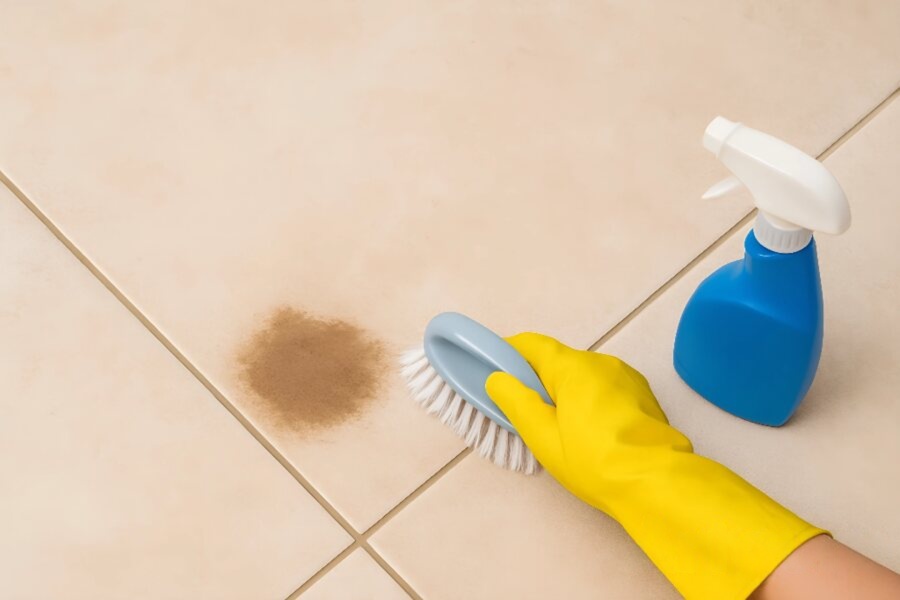
Remove Stubborn Stains From Tile Floors Effectively
Have you ever tried cleaning the stain on your tile floor so hard that you nearly wondered why you were doing what you were doing with your life? We have all been victims of that unyielding spot on the floor which is not ready to move, even after you have thrown every cleaning product on it. The tile floors are very strong and attractive; however, dangerous stains may make them look dirty, nasty, and worn. The good news? You do not require the help of professional equipment in order to restore that spotless shine. Even the most stubborn stains can be safely and effectively removed using the correct technique and sometimes, a lot of patience.
We will also learn cleaning solutions that have been proven, cleaning soft solutions, and cleaning agents, which can be used to fight tough stains, yet they do not harm the surface in this guide. It may be greasy, hard water, grout grime or something you do not even know, but we have the answer to your problem.
1. Begin with a Light cleaning of Surfaces
Always start with a simple cleaning schedule before going to the extreme of having strong professional cleaners. Dust, loose dirt, and surface chemicals may cause the stains to appear with more intensity. Start by sweeping or vacuuming the floor and then mop it with a mixture of warm water and mild liquid soap. In some cases, even after a mere wash, the stain can be removed in case it is a surface mark only. This will also avoid scratching as you go to more difficult stains at a later date. Many homeowners find that consulting bond cleaners for guidance can help maintain a safe and effective cleaning routine.
2. Baking Soda on Organic and Greasy Stains
The baking soda is a miracle-working ingredient with tile floors. In case it is a food spill, grease or any organic stain, a paste of baking soda will do a wonderful job. Add a few tbs. of baking soda to warm water until it turns into a thick paste. Put it on the stain and allow it to dry after 10 to 15 minutes. Next, rub lightly with a soft brush or an ancient toothbrush. Baking soda has fine particles that are used in breaking down the stain without scratching the tiles. Wash the section with a lot of water and do it again. It is natural, safe and very effective.
3. Remover of Stains With Vinegar and Water Solution
Vinegar is a strong natural cleaner, particularly on stains brought on by soap scum, water spots and general dirt. With cloudy build-up, vinegar will cut through the cloudy build-up, and the glossy finish will be restored on your tiles. Nevertheless, one should not apply vinegar to such natural stone tiles as marble or granite as it can destroy the surface.
4. Hydrogen Peroxide for Deep Stains
Hydrogen peroxide is an excellent follow-up to the difficult-to-remove stains. It is particularly effective in applied it on hard to hard-to-remove organic stains like wine, coffee, or pet accidents. The latter may be sprayed or simply poured onto the stain. Let it dry after 10 minutes, and scrub a bit. The carbonated effect assists in removing the stains that have settled on the floor of the tile. Clean and then rinse down to get any residual cleaning.
5. Cleopatra Lemon Juice Hard Water Stains
Hard water stains cause the appearance of chalky whites on your floor, which may destroy the look of your floor. The acidity of lemon juice is not too strong to get rid of the mineral deposits. Put fresh lemon juice on the stained area and after 10 minutes it will be dry. Then, wipe and scrub, and finally wipe. Natural citrus oils make your tiles smell good and bring back their shine. Once again, lemon should not be placed on natural stone tiles because it is acidic.
6. Commercial Tile Cleaners should be tried on Extreme Stains
There are some cases when it may be necessary to use home remedies; however, in cases where it comes to years of accumulated grime, rust stains, or deeply rooted marks, home remedies might not be sufficient. In this instance, there are commercial tile cleaners that are designed with ceramic or porcelain tiles in mind. Find pH-neutral formulas that clean and do not harm the flooring. It is good to test a small, concealed part before proceeding to put the product on the whole stain. Use chemicals with great care and make sure that there is proper air circulation during use.
7. Remember to Clean the Grout
Even most of the stains on tile floors are not on the tile, but on grout. Grout is dirty or stained and resulting in the entire floor appearing patchy and dull. To eliminate dirt and discolored areas in the grout, First prepare a thick paste of baking soda and water. The floor tiles’ darkness will disappear immediately together with the brightness of the whole floor and the newness of the tiles. A combination of baking soda and water should be applied to the grout lines and the mixture should be sprayed with vinegar.
Conclusion
Tile floors with ugly stains may seem a big problem, but it is not so if correct techniques of expert cleaning coupled with regularity are employed. Eventually, the tiles will reveal their original beauty. With a natural cleaner like baking soda, vinegar, or lemon, or even stronger ones like Hydrogen peroxide and commercial products, every stain type is assured to find a solution. And remember that you should love your grout too, and get used to very basic clean-up behaviours to have your floors gleaming in the long run. For any guidance or questions, you can always reach out anytime.